
Using the Hearing Path app for precision hearing
Do you need to get used to different sounds and practice, or improve your accuracy in hearing speech? If you have an Android or Apple mobile phone or an iPad tablet, you can download the hearing training app produced by Outloud for free from the app store, which helps you practice recognizing words and sentences, as well as listening to music.
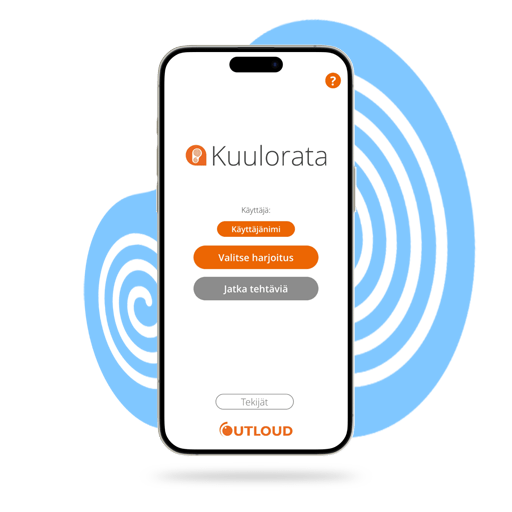
Easy-to-use application
The Kuulorata application is very clear and simple to use. With its easy usability and gamification, the application supports independent practice. The difficulty level of the exercises can be selected and the application provides feedback on success in the tasks and progress. The exercises are also made interesting by their game-like format: you can also have fun while practicing with sentence completion tasks, memory games and bingo!
The app features a female and a male speaker. The user can choose whether to listen to the exercises spoken by a female or male speaker, or try both.
The Kuulorata app lets you listen to words and sentences
- without background noise
- in the background noise
- in the background speech noise
- with echo
Why is it good to do listening exercises?
The Hearing Path app allows you to train your hearing. The app includes various music and speech tasks as well as games. Studies show that hearing exercises are beneficial for people who use hearing aids [1]. For example, even just using a hearing aid regularly starts to rehabilitate your hearing: sounds become stronger and previously inaudible sounds become audible. When you add enhanced hearing exercises to this full-time hearing rehabilitation of everyday sounds, you get even more benefits.
In addition, auditory exercises support brain functions related to the processing of auditory information, such as auditory memory [2]. The Kuulorata application aims to support independent practice through its gamification and ease of use [3]. In addition to listening to speech, it is recommended to also do the music tasks in the application. Listening to music develops many auditory skills, such as the ability to distinguish, recognize and localize sounds [4].
Listening exercises aim to
- to get used to the use of hearing aids and cochlear implants.
- to improve the benefits derived from them.
- to increase their regular use.
Help with using and getting used to a hearing aid or cochlear implant
Sari Vikman, a speech therapist at TAYS Hearing Center, is also one of the group of speech therapists who developed tasks for the Kuulorata app. According to her, listening with hearing aids or a cochlear implant often requires practice in order to get the best possible benefit from them. “It is most difficult to understand speech when there is background noise or the space is echoing,” says Sari, drawing on her long-standing practical experience.
Using a hearing aid, cochlear implant, and listening exercises can help you understand speech better. It usually increases your confidence to participate in interpersonal communication and also makes it easier. Science has also shown that effective use of your hearing helps maintain mental alertness.
Listening to music develops many auditory skills, such as the ability to distinguish, identify and localize sounds. Research has shown that there is a strong connection between the perception of music and speech. “That is why we wanted to strongly include music in the Kuulorata application and create versatile tasks for distinguishing and identifying sounds, musical instruments and songs,” emphasizes Kerttu Huttunen, also a speech therapist and professor of speech therapy at the University of Oulu. Kerttu is delighted that talented students and colleagues were selected to perform the tasks. In addition to listening to speech, it is therefore highly recommended to also do the music tasks in the application.
The Kuulorata application is the result of a long development process
The need for hearing exercises grew particularly strongly in the 1990s, when cochlear implants were introduced into hearing rehabilitation. This is because getting used to using a new aid often requires practice at first, whether it is a hearing aid or a cochlear implant.
Speech therapist Eila Lonka and phonetician Reijo Aulanko translated from English and adapted into Finnish the hearing training material from the Cochlear company, which manufactures cochlear implants. Puheterapeuttien Kustannus published the Kuulorata käyttömä material in a paper version in 1999. When mobile phones began to be widely used by both children and adults, speech therapist Sari Vikman saw the need to transfer the hearing training materials to a digital format. As a result, the KuulorataPilot application was completed in Outloud in 2017, which has served as the basis for the current Kuulorata application. Speaking material has been selected from previous tasks for Kuulorata, partially edited and expanded. In addition, many new exercises have been created. The music section is also a completely new production.
[1] [1] Stropahl, M., Besser, J. & Launer, S. (2020). Auditory training supports auditory rehabilitation:
A state-of-the-art review. Ear and Hearing, 41(4), 697–704.
[2] Henshaw H., & Ferguson, M. A. (2015). Auditory training can improve working memory, attention, and communication in adverse conditions for adults with hearing loss. Frontiers in Psychology, 6, 556. doi: 10.3389/fpsyg.2015.00556
[3] Henshaw H., & Ferguson, M. A. (2013). Efficacy of individual computer-based auditory training for people with hearing loss: A systematic review of the evidence. PLoSOne 8(5), e62836. doi: 10.1371/journal.pone.0062836
[4] Ab Shukor, N. F., Lee, J., Seo, Y. J. & Han, W. (2021). Efficacy of music training in hearing aid and cochlear implant users: A systematic review and meta-analysis. Clinical and Experimental Otorhinolaryngology, 14(1), 15–28. doi: 10.21053/ceo.2020.00101
